Wednesday, November 27, 2013

New paper: “Growth in New Disabled-Worker Entitlements, 1970–2008”

"Growth in New Disabled-Worker Entitlements, 1970–2008"
Social Security Bulletin 73(4): 25-48, 2013

DAVID PATTISON, Government of the United States of America - Social Security Administration
Email: david.h.pattison@ssa.gov
HILARY WALDRON, U.S. Social Security Administration
Email: hilary.waldron@ssa.gov

In this article, we analyze the growth in new disabled-worker entitlements from 1970 through 2008. The number of newly entitled workers has increased along with the working-age population because more women worked and became insured for disability, and the baby boom generation moved into disability-prone ages. We decompose this incidence growth into the part attributable to those factors and a residual part attributable to factors like program changes or business cycle fluctuations.

We find that the three factors — (1) population growth, (2) growth in the proportion of women insured for disability, and (3) movement of the large baby boom generation into disability-prone ages — explain 90 percent of the growth in new disabled-worker entitlements over the 36-year subperiod (1972–2008) and 94 percent of the growth over the second half of that period (1990–2008). Comparing the earlier period to the later, a seeming speedup in disability incidence in 1990–2008 relative to 1972–1990 disappears once we account for the changing demographic structure.

Read more!

Monday, November 18, 2013

Washington Post: Harkin-Sanchez benefit increase/tax max plan “wrong-headed”

The Washington Post’s editors weigh in against legislation from Sen. Tom Harkin and Rep. Linda Sanchez that would increase social security benefits and COLAs, funded by eliminating the Social Security “tax max”:

The fiscal predicament facing the U.S. government is a double one: how to bring taxes and spending into rough long-term balance while ending the squeeze on non-entitlement spending enshrined in current law. It’s not an easy task. It won’t get any easier if progressives define progressivism as opposition to budgetary realism.

Check it out here.

Read more!

Friday, November 15, 2013

Do seniors steal jobs from younger workers?

Ask my AEI colleague Sita Slavov, over at AEIdeas…

Read more!

Urban Institute’s updated lifetime Social Security and Medicare taxes and benefits

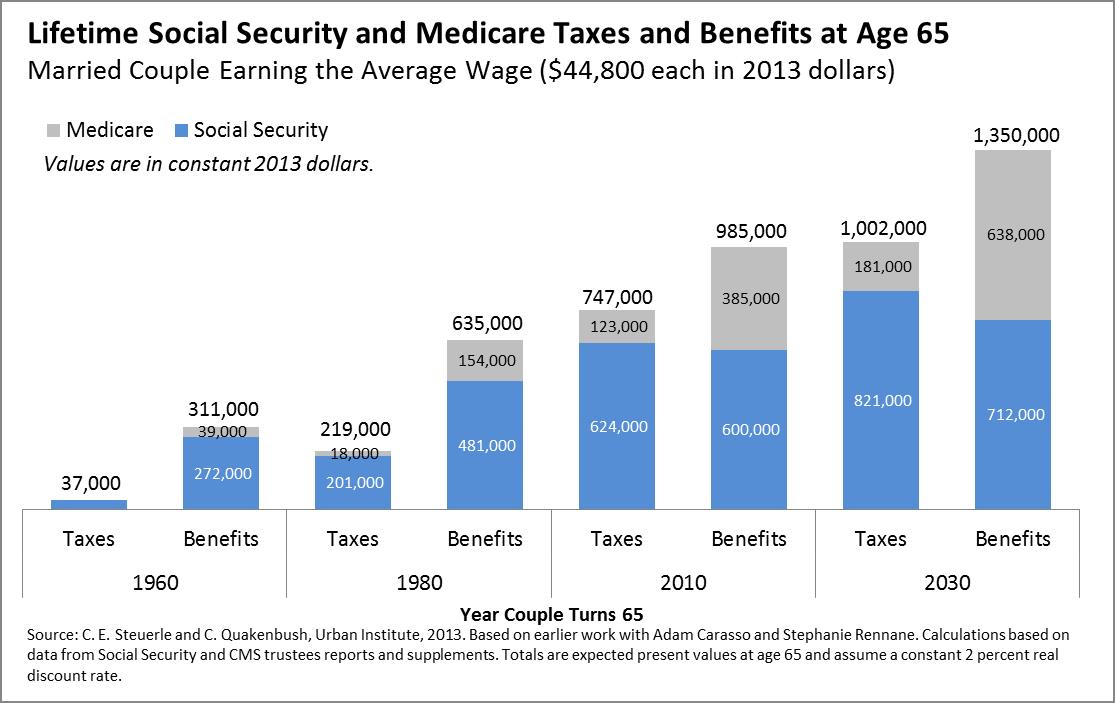
Gene Steurle and Caleb Quackenbush of the Urban Institute have updated their figures showing the lifetime Social Security and Medicare taxes people pay, based on when they’re born, and the lifetime benefits they can expect to receive.

There’s an interesting pattern here: for early cohorts, say the 1960 cohort shown on the left, the real money was in Social Security: you paid a little Social Security taxes and received a load of benefits. Medicare was a bonus: people at that time paid next to no Medicare taxes, but the lifetime benefits weren’t all that much.

Today, it’s a different story. Social Security has turned the corner, both through higher taxes and relatively lower benefits (through the retirement age increase), meaning that a typical person retiring today will pay more in Social Security taxes than they’ll receive back in benefits.

So we’ve saved the budget, right? Wrong. Medicare has grown so much in terms of cost/generosity that a typical person retiring today will receive around $260,000 more in Medicare benefits than they paid in taxes.

Where’s the money going to come from to pay for that? Well, that’s the question…

Read more!

Wednesday, November 13, 2013

Has Social Security redistributed from whites to minorities – or is it the othe rway around?

Caleb Quakenbush, Karen E. Smith and Eugene Steuerle of the Urban Institute have an interesting new study looking at how Social Security redistributes according to race, a topic which has long generated controversy in policy circles. But the authors take a new angle on things: looking not only at how Social Security taxes and benefits are distributed within a single birth cohort, but also across time. For instance, Social Security was far more generous to earlier birth cohorts (who tend to be more predominantly white) and less generous to later ones (who have greater numbers of minorities). As a result, the program may be redistributing from these younger, less-white generations to older, ‘whiter’ generations.

In any case, here’s the abstract:

This brief considers how Social Security’s many benefit and tax features have redistributed across groups over time. Using Current Population Survey data from 1970 through 1994 and microsimulation projections from the Urban Institute’s DYNASIM3 model, we find that for many decades, Social Security redistributed from blacks, Hispanics, and other people of color, to whites. These transfers will likely to continue in future decades. Our findings suggest that future reforms that place the burden of Social Security reform solely on younger, more diverse generations may have undesired distributional consequences if the aim of the program is to provide greater relative protections to more vulnerable groups.

You can check out the whole article here.

Read more!

Tuesday, November 12, 2013

Upcoming event: “The Chained CPI and Its Impact on Social Security”

National Economists Club
11/14/13 with Michael Horrigan, Bureau of Labor Statistics Chinatown Garden Restaurant 618 H St NW
Date: 14 Nov 2013 12:00 PM

Mike Horrigan

Michael Horrigan

Associate Commissioner for Prices and Living Conditions

U.S. Bureau of Labor Statistics

“The Chained CPI and Its Impact on Social Security”

There is a tremendous amount of policy interest in the potential use of the chained CPI-U for cost of living adjustments to various social programs, including social security.  This statistical / survey methodology talk is intended to provide the audience with a thorough background on and understanding of the building blocks of the CPI-U, the CPI-W, the chained CPI-U as well as the much discussed experimental CPI for the elderly (CPI-E). How social security payments are adjusted using the CPI-W is presented as well as how social security payments would have varied in the past using alternative indexes for cost-of-living adjustments.  Finally, the challenge of constructing a production ready non-experimental CPI for a demographic group such as the elderly is discussed.

Reservations are open through Wednesday, 11-13-13

Press: Please email :info@national-economists.org with your attendance status and the date of attendance. It will be assumed that lunch is NOT requested.   If lunch is requested, please contact me in advance, prior to the date of the event, for registration and payment instructions at the member rate.

Credit Card payment is non refundable but you may substitute someone in your place for attendance.

http://thenationaleconomistsclub.shuttlepod.org/ViewEvent.ashx?eventId=778795

Read more!

Center for Retirement Research Dissertation Fellowships

The Center for Retirement Research at Boston College announces the 2014 Dissertation Fellowship Program for research on retirement income and policy issues, funded by the U.S. Social Security Administration.

  • The Dissertation Fellowships support doctoral candidates writing dissertations on retirement income and policy issues. The program is open to scholars in all academic disciplines.
  • Up to two fellowships of $28,000 will be awarded.
  • The submission deadline for proposals is Friday, February 14, 2014. Award recipients will be announced by April 2014.
  • Visit the Dissertation Fellowship website to view the proposal guidelines.
For questions, please contact:
Marina Tsiknis
tsiknis@bc.edu
617-552-1092 Read more!