Monday, August 11, 2014

CRFB: The Cost of Delaying Social Security Reform

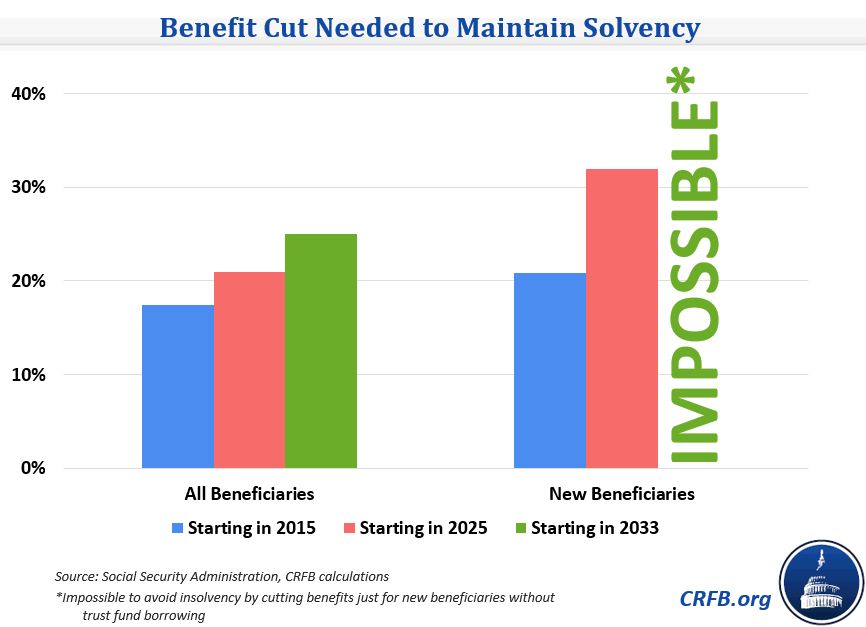
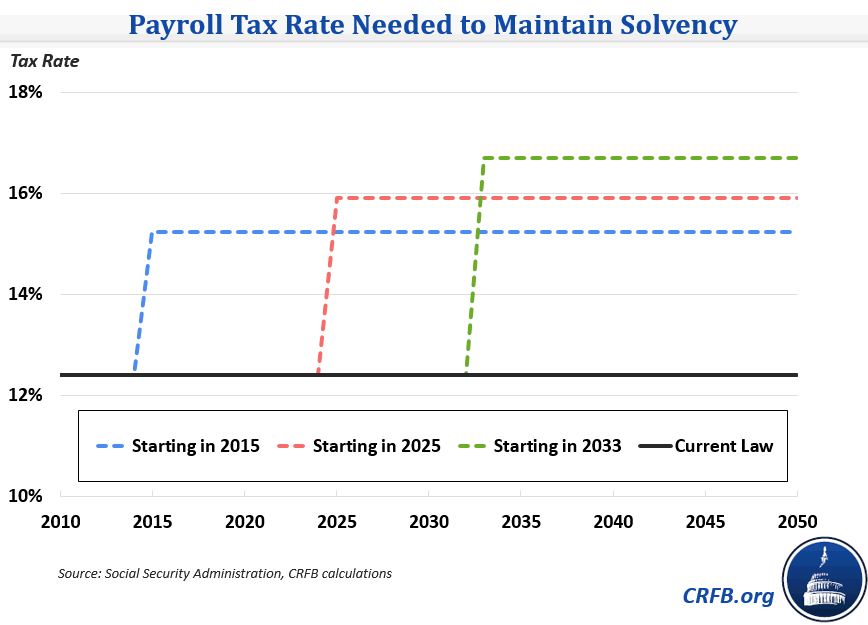
The Committee for a Responsible Federal Budget has an update to their memo on the costs of delaying a fix for Social Security.

But it’s not just fancy charts: check out the whole story here.

The short story – as I see it, at least: Social Security has a big shortfall which needs to be filled either by raising taxes or cutting benefits. Any solution will be painful, but it’s less painful if we spread a little around to everybody. For each year we delay, we’re exempting another cohort of participants from the pain of reform, which means more for everyone else. That’s not good policy and it’s also not very fair.

Read more!

MacGuineas: Social Security Demystified

Maya MacGuineas of the Committee for a Responsible Federal Budget debunks some Social Security myths in an op-ed piece for the McClatchy syndicate.

Check it out here.

Read more!

Brown: “The Social Security Earnings Test Is Not A Tax”

Over at Forbes, University of Illinois economist Jeffrey Brown hits on one of my personal pet peeves: the misunderstanding of how Social Security’s “earnings test” workers. Retirees treat it as a “tax” on work, in part because SSA always told them it was. As a result, retirees work less.
In reality, as Jeff shows, the earnings test isn't a tax. Check out his whole piece for details.
And for more info, see my 2008 AEI paper: The Tax That Wasn’t. Read more!

Wednesday, August 6, 2014

Concord Coalition: “Impending Crisis Should Force Action On Social Security in the Next Congress”

Ben Ritz of the Concord Coalition delivers a nice wrap-up of the 2014 Social Security Trustees Report as well as making the case for reform.

You can check out his piece here.

Read more!

Tuesday, August 5, 2014

New Paper: “How Social Security Reform Could Benefit Workers”

The National Center for Policy Analysis has released “How Social Security Reform Could Benefit Workers,” by Liqun Liu, Andrew J. Rettenmaier and Thomas R. Saving.

Congress is once again considering changes to Social Security in an attempt to "save" the program. Social Security benefit payments have exceeded tax revenues since 2010; the funding deficit is growing and, barring reform, will continue to grow indefinitely. Higher tax revenues are necessary to fund benefits as they are currently calculated.

When workers consider the retirement benefits they expect from Social Security they must also consider the taxes paid during their working years. Average-wage workers retiring today have paid more Social Security taxes than they will receive in retirement benefits, so their net benefits are negative. For future workers, who will have to pay higher taxes to finance the program’s growing expenditures, net benefits will dip even lower.

The system is financed on a pay-as-you-go basis where current tax payments are transferred to current retirees. Changing demographics have resulted in a reduction in the number of workers supporting each retiree and a corresponding need for higher tax rates. The Social Security system cannot escape the ongoing demographic shift, but its share of the economy can be reduced and workers can escape the higher taxes necessary to fund the current program if they are willing to take lower Social Security benefits when they retire.

You can read the whole document here.

Read more!
Kotlikoff: Entitlement Debt is Off the Books

In the New York Times, Boston University economist Larry Kotlikoff writes that policymakers should pay more attention to the “fiscal gap,” which goes beyond measuring government debt to include unfunded obligations for Social Security and Medicare.

Check it out here.

Read more!

Monday, August 4, 2014

Video from CRFB Event: "Decoding the Social Security Trustees Report."

On July 29, 2014, the Committee for a Responsible Federal Budget held a forum examining the latest numbers on Social Security's finances. Experts weighed in on what the report says about Social Security's solvency and what should be done to ensure it will be there for future generations.

Reps. Tom Cole (R-OK) and John Delaney (D-MD) talked about their legislation to establish a Social Security reform commission. Social Security Chief Actuary Stephen Goss gave a presentation on the report and what it means for Social Security's future. 

The event also included a panel with experts from a wide variety of perspectives, including the American Enterprise Institute's Andrew Biggs, the Mercatus Center's Jason Fichtner, Third Way's Jim Kessler, and the Center on Budget and Policy Priorities's Paul Van de Water. The panel was moderated by Damien Paletta of The Wall Street Journal.


Read more!