Wednesday, July 16, 2014

New papers from the Social Science Research Network

"The Affordable Care Act in an Economy with Federal Disability Insurance"

YUE LI, National Bureau of Economic Research (NBER)
Email: liyue01@gmail.com

This paper examines the effects of the Affordable Care Act (ACA) by considering a dynamic interaction between extending health insurance coverage and the demand for federal disability insurance. This paper extends the Bewley-Huggett-Aiyagari incomplete markets model by endogenizing health accumulation and disability decisions. The model suggests that the ACA will reduce the fraction of working-age people receiving disability benefits by 1 percentage point. In turn, the changes associated with disability decisions will help fund 47 percent of the ACA's cost. Last, compared to the ACA, an alternative plan without Medicaid expansion will reduce tax burdens and improve welfare.

"Economic Analysis of Social Security Survivors Benefits"

YUE LI, National Bureau of Economic Research (NBER)
Email: liyue01@gmail.com

This paper analyzes the impacts of social security survivors benefits, a program that has received little attention in the literature. Survivors benefits help insure against mortality differences within and across cohorts in addition to the uncertainties of income and family structures. The risk spreading provided by survivors benefits, however, is funded via taxes that distort individual decisions. To capture the trade-off, this paper designs and calibrates a dynamic model, in which mortality rates are negatively correlated with income. The model suggests that removing dependent children benefits generates ex-ante utility losses, but removing aged spousal benefits produces ex-ante utility gains.

"Valuation and Risk Assessment of Disability Insurance using a Discrete Time Trivariate Markov Renewal Reward Process"
Insurance: Mathematics and Economics, Vol. 53, 2013

ALEXANDER MAEGEBIER, University of Erlangen-Nuremberg - Department of Insurance Economics and Risk Management
Email: alexander.maegebier@fau.de

In disability insurance, the impact of the duration since the inception of disability on future recovery and mortality rates has been modeled by bivariate Markov renewal processes and the associated semi-Markov process, but these processes do not incorporate potential dependences between the durations in two successive states. Thus, the aim of this paper is to introduce a discrete time trivariate Markov renewal reward model, an associated formula for higher moments and a corresponding simulation that include the potential dependence between the durations, i.e. the inter-arrival times, in two successive states. The proposed model is compared with two alternative models that do not include this dependence.

"The Cost-Savings of Expanding Medicaid Eligibility to Include Currently Uninsured Homeless Adults with Substance Use Disorders"
Journal of Behavioral Health Services & Research 41.2 (2014): 110-124

JULIA ZUR, George Washington University
Email: jzur@gwu.email.edu
RAMIN MOJTABAI, Johns Hopkins University
Email: rmojtaba@jhsph.edu
SUHUI LI, George Washington University
Email: suhuili@gwu.edu

Following the June 2012 Supreme Court ruling that states are no longer mandated to expand their Medicaid programs in 2014 as part of the Affordable Care Act, many states plan to opt out of the expansion, citing affordability as their primary concern. In response to this controversy, the present study evaluated the cost savings of expanding Medicaid coverage to include currently ineligible homeless adults with substance use disorders, a subset of the population that incurs some of the greatest societal costs and is disproportionately impacted by uninsurance. Using a time horizon of 7 years, separate analyses were conducted for state and federal governments, and then a final analysis evaluated the combined costs for the other two models. Results of the study demonstrate that, although the expansion will be associated with a net cost when combining state and federal expenses and savings, states will experience tremendous savings if they choose to participate.

Read more!

Tuesday, July 15, 2014

Wall Street Journal: “Miscalculating the Retirement Income You'll Need”

I have an op-ed in today’s Wall Street Journal co-authored with Syl Schieber which draws on our larger piece on the “retirement crisis” that appears in the Summer issue of National Affairs. The Journal piece focuses on how SSA calculates replacement rates for Social Security and how that differs from the way financial advisors calculate them. Here’s a snippet:

It is now conventional wisdom that Americans face a retirement "crisis," in part because Social Security benefits are seen as inadequate. For instance, the Social Security Administration's website explains that "most financial advisers say you'll need about 70% of your pre-retirement earnings to comfortably maintain your pre-retirement standard of living." It then notes that "under current law, if you have average earnings, your Social Security retirement benefits will replace only about 40%."

That line of thinking is misleading, often cited by progressives fighting benefit reforms that would address Social Security's $10 trillion shortfall. Here's why: Financial advisers do not calculate replacement rates the same way the Social Security Administration does. When the calculations are consistent, the replacement rate paid by Social Security comes closer to 60%, which substantially changes the retirement-income picture.

Financial advisers measure replacement rates relative to final earnings, generally meaning they divide the first year of retirement income by a worker's final year of working income, or average pay during the past five working years. The SSA, on the other hand, measures replacement rates relative to the wage-indexed average of lifetime earnings. "Wage indexing" increases past earnings to reflect the growth of average wages. These are very different numbers that produce very different outcomes.

Check out the whole article here. Related: my 2008 article on measuring replacement rates co-authored with Glenn Springstead of SSA.

Read more!

Thursday, July 10, 2014

Upcoming event: "Boosting Economic Mobility through Prize-Linked Savings"

Join us for lunch at ICI on Tuesday, July 22 for a discussion with Stuart Butler and David C. John on their paper "Boosting Economic Mobility through Prize-Linked Savings"

View this email in your browser

Stuart Butler
Distinguished Fellow and Director, Center for Policy Innovation
The Heritage Foundation

David C. John
Senior Strategic Policy Advisor
AARP Public Policy Institute

JOIN US FOR A LUNCH MEETING
Discussing:
"Boosting Economic Mobility through
Prize-Linked Savings"

with
Stuart Butler and David C. John
Tuesday, July 22 from Noon to 1:00 at

Investment Company Institute
1401 HStreet, NW
Suite 1200
Washington, DC 20005

RSVP

(Lunch will be provided)

Abstract
The savings rate in America has been in decline for three decades, with roughly one-third of households having no savings at all. Analyses of economic mobility explore why some people are successful in moving up the economic ladder during their lifetime while others are not. While there is much debate about the degree of opportunity in America, there is general agreement that there seem to be significant obstacles facing Americans who start out in households at the bottom end of the income spectrum. But even for those starting at the bottom, lifetime trajectories vary widely. The habit of saving is a critically important complement to education and social “capital” needed for upward mobility. But we need to recognize that there are many Americans who are not inclined to take part in traditional programs designed to build a savings habit. For these Americans, financial incentives and tools with approaches that have a more emotional appeal are a more effective way of creating a culture of savings by channeling the instinct to gamble into systematic savings. This approach, known as “prize-linked savings” employs the techniques of behavioral economics to turn a behavior pattern into a savings habit that enhances the economic mobility of a household.

Facebook

@SandRFDN

Blog

 
Read more!

Wednesday, July 9, 2014

Are SSA Judges Rubber-Stamping Applications for Disability Benefits?


From the National Center for Policy Analysis

June 16, 2014

The Fiscal Times reports that some judges are approving disability insurance at an alarming rate, often approving claims without holding hearings.

When an American applies for disability benefits and is twice denied them, he can appeal to a Social Security Administrative Law Judge (ALJ), who is required to consider the case record to determine eligibility for benefits.

The rubber-stamping revelation comes from a new report from the House Oversight and Government Reform Committee:

  • On average, ALJs approve 58 percent of disability claims with an average lifetime benefit of $300,000 per person.
  • From 2005 to 2013, ALJs put 3.2 million Americans on disability programs, costing $1 trillion.
  • During this period, more than 1.5 million Americans joined the federal disability program thanks to ALJs with allowance rates above 75 percent, and 650,000 people were placed in the programs by ALJs with allowance rates above 85 percent.

The House report identifies three judges that approved disability benefits in nearly every case, together awarding lifetime benefits of almost $10 billion. According to the report, "[T]hese judges rubber stamped nearly every claimant before them for a lifetime of benefits at taxpayer expense." For example:

  • Judge Harry Taylor, who has worked within the Social Security Administration for a quarter-century, approved 94 percent of the cases that came to him. Of those, 68 percent were approved without holding a hearing.
  • While Judge Taylor testified to Congress that he keeps an open mind on every case, the House Oversight report revealed that a majority of the cases Taylor approved contained expert medical opinions that were "inconsistent with his findings of disability."
  • Similarly, Judge David Daugherty had an approval rate of nearly 99 percent before retiring in 2011. His disability awards to 8,413 people added up to $2.5 billion in lifetime benefits. Almost half of the benefits were awarded without a single hearing.

According to the report, some judges are approving cases at high rates in order to reduce backlogs. The average disability hearing processing time has fallen from 512 days in 2007 to less than one year in 2012. However, not all judges are "rubber-stamping" disability claims, and the overall allowance rate fell from 72 percent in 2005 to 56 percent last year.

19.4 million Americans are receiving $200 billion in benefits through the Social Security Administration's two disability programs, and taxpayers are left to shoulder the burden of the billions of dollars in improper payments. The Social Security program is on track to run out of funds by 2016.

NCPA Senior Fellow Pamela Villarreal recently issued a study highlighting the growing number of women on disability.

Source: Brianna Ehley, "Judges Who Rubber Stamp Disability Claims are Bankrupting the System," The Fiscal Times, June 10, 2014; "Systemic Waste and Abuse at the Social Security Administration: How Rubber-Stamping Disability Judges Cost Hundreds of Billions of Taxpayer Dollars," Staff Report, Committee on Oversight and Government Reform, U.S. House of Representatives, June 10, 2014.

Read more!

Tuesday, July 8, 2014

New publication: “Is There A Retirement Crisis?”

I have a long article co-authored with Syl Schieber in the summer issue of National Affairs which looks at the variety of factoids and studies suggesting that Americans are facing a “retirement crisis.” While many Americans no doubt are undersaving for retirement, nearly every study claiming a crisis makes a number of at least debatable methodological choices. We examine many of these choices and give, I believe, a more rounded view of the issue.

This piece should be of interest to anyone interested in retirement security, including Social Security reform. You can read it online here.

Read more!

A confirmation fight for SSA?

President Obama has nominated Carolyn Colvin, the long-serving acting Commissioner of the Social Security Administration, to become Commissioner in her own rite. I’d be pretty surprised if she weren’t confirmed.

But, as National Review reports, some Republicans in Congress haven't been happy with her performance to date, in terms of reducing program costs or getting on top of administrative law judges who are seemingly over-enthusiastic in approving disability benefits applications. Will it derail her nomination? Probably not. But it will raise the visibility of problems at the agency and in the Social Security program as a whole.

Read more!

Thursday, July 3, 2014

Upcoming event: National Academy of Social Insurance Social Security Seminar

National Academy of Social Insurance

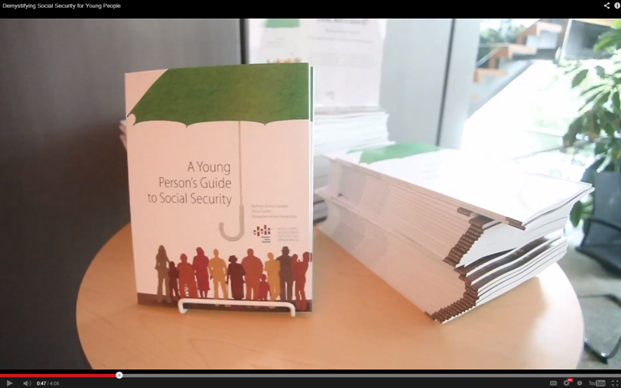
Register now to join the National Academy of Social Insurance for a free day-long seminar on Social Security and how it impacts young people. Don’t miss this opportunity to connect with other interns, students and young professionals and to interact with Social Security policy experts from leading non-profits, government organizations, advocacy groups, and think tanks. Light breakfast and lunch will be provided.

This is the first of two NASI 2014 Summer Academies. Demystifying Medicarewill be held on July 24th, also at the Kaiser Family Foundation’s Barbara Jordan Conference Center.

Join the conversation on Twitter by following NASI (@socialinsurance) and using the event hashtag: #socsec14.

Sessions Include:

  • Why is Social Security Important? And Why is it Important to Young People?
  • Social Security: How Does it Work?
  • Straight Talk on Social Security's Financing and Policy Options
  • Unfiltered: Two Visions for Social Security's Future
  • Your Solution For Social Security

View the full agenda and speakers.

Watch a short video to get a sense of the event:

» Register Now

Read more!