Monday, October 19, 2020

How Would Joe Biden Reform Social Security and Supplemental Security Income?

How Would Joe Biden Reform Social Security and Supplemental Security Income?

By Karen E. Smith, Richard W. Johnson and Melissa M. Favreault of the Urban Institute

October 8, 2020

DOWNLOAD PDF

Abstract

Joe Biden has proposed increasing Social Security revenue, enhancing Social Security benefits, and expanding Supplemental Security Income, a program that provides cash benefits to low-income older adults and people with disabilities. Our projections show that his proposals would lift more than 1 million people out of poverty in 2021 and cut the poverty rate for adult Social Security beneficiaries over the coming decades by more than half. We project that by extending the Social Security payroll tax to earnings above $400,000, his plan would close about a quarter of the program’s long-term funding deficit and extend the life of the trust funds by about five years.

Read more!

Tuesday, September 8, 2020

Tomorrow! The Savings and Retirement Foundation, featuring Andrew Biggs

The Savings and Retirement Foundation

Join us Wednesday, 9 September

For a Zoom Talk by

Andrew Biggs

Senior Fellow at AEI

When he will speak about his new paper

How do Children Affect the Need to Save for Retirement?
Via Zoom

12:00 pm

RSVP

via

Zoom

Andrew G. Biggs is a resident scholar at the American Enterprise Institute, where he studies Social Security reform, state and local government pensions, and public sector pay and benefits. Biggs was previously the principal deputy commissioner of the Social Security Administration.

Read more!

Monday, August 31, 2020

Weaver: SSI awards for the disabled lowest in 20 years

My former SSA colleague David Weaver writes in The Hill that benefit awards for Supplemental Security Income (SSI), a means-tested benefit for the blind, disabled and aged, have dropped significantly during the Covid recession


In May, June, and July of this year, SSA awarded 5,038, 4,572, and 5,122 elderly individuals SSI benefits, respectively. The June award figure is the smallest number of monthly awards for the elderly in the last 20 years. The May and July figures are the second and third smallest in the last 20 years. Further, the total number of awards in these three months is 42 percent lower than the number of awards to the elderly for the comparable 3-month period in 2019.

You can check out his whole column here.

Read more!

Friday, June 19, 2020

New issue of the Journal of Pension Economics & Finance

Journal of Pension Economics & Finance
Volume 19 / Issue 3, July 2020
Published Online June 2020

Employment and substitution effects of raising the statutory retirement age in France
Simon Rabaté, Julie Rochut

Public pension wealth and household asset holdings: new evidence from Belgium
Mathieu Lefebvre, Sergio Perelman

Supporting decision-making in retirement planning: Do diagrams on Pension Benefit Statements help?
Féidhlim P. McGowan, Peter D. Lunn

On the effect of financial education on financial literacy: evidence from a sample of college students
Agar Brugiavini, Danilo Cavapozzi, Mario Padula, Yuri Pettinicchi

What determines financial literacy in Japan?
Yoshihiko Kadoya, Mostafa Saidur Rahim Khan

The implication of the hyperbolic discount model for the annuitisation decisions
Anran Chen, Steven Haberman, Stephen Thomas

Determinants of second pillar pension reforms: economic crisis and globalization
Joelle H. Fong, Markus Leibrecht

Systematic longevity risk: to bear or to insure?
Ling-Ni Boon, Marie Brière, Bas J. M. Werker

Policy Paper/Brief

Why are US men retiring later?
Wenliang Hou, Alicia Munnell, Geoffrey Todd Sanzenbacher, Yinji Li

Read more!

Friday, May 22, 2020

Brenton Smith: “Is the Social Security Trust Fund Real"?”

Writing for FedSmith: check it out here.

The Social Security Trust Fund has been around for 80 years. Over that time, its role within the program has changed, but the argument has remained the same. Is the Trust Fund real or simply an accounting ledger where wonks play with imaginary cash?

It has lingered for decades because there is no right or wrong answer to the question of whether the Trust Fund is real. It is a theoretical question where different assumptions lead to opposite conclusions.

Read more!

Tuesday, May 12, 2020

New paper from the NBER: “Social Security Wealth, Inequality, and Lifecycle Saving”

Social Security Wealth, Inequality, and Lifecycle Saving
John Sabelhaus and Alice Henriques Volz #27110
  
Abstract:

Wealth inequality in the US is high and rising, but Social Security is generally not considered in those wealth measures. Social Security Wealth (SSW) is the present value of future benefits that an individual will receive less the present value of future taxes they will pay. When an individual enters the labor force, they generally face a lifetime of taxes to pay before they will receive any benefits, and thus their initial SSW is generally low or negative. As an individual works and pays into the system their SSW grows and generally peaks somewhere around typical Social Security benefit claim ages. The accrual of SSW over the working life is most important for lower-income workers because the progressive Social Security benefit formula means that taxes paid while working are associated with proportionally higher benefits in retirement. We estimate SSW for individuals in the Survey of Consumer Finances (SCF) for 1995 through 2016 and use a pseudo-panel approach to empirically demonstrate those lifecycle patterns. We also show that including SSW in a comprehensive wealth measure generally reduces estimated levels of wealth inequality but does not reverse the upward trend in top wealth shares.

Read more!

Friday, May 1, 2020

Social Security’s Financial Outlook: The 2020 Update in Perspective

by Alicia H. Munnell, Center for Retirement Research at Boston College

IB#20-7

The brief’s key findings are:

  • The 2020 Trustees Report, which was prepared before the pandemic, shows:
    • Social Security’s 75-year deficit increased from 2.78 percent to 3.21 percent of payroll.
    • Trust fund depletion remains at 2035, after which payroll taxes still cover about three quarters of promised benefits.
  • This shortfall is manageable, and the pandemic is unlikely to fundamentally alter the long-term financial status of the program.
  • Today’s crisis has also underscored the importance of Social Security, which continues to provide a steady source of income to millions of Americans.
  • Therefore, once the crisis subsides, stabilizing Social Security’s long-term finances should be a high priority to ensure that Americans have full confidence in its future
DOWNLOAD FULL BRIEF
Read more!

Wednesday, April 22, 2020

2020 Social Security Trustees Report Released

The Social Security Trustees released their 2020 annual report on the program’s current and future financial health.

The projected date of trust fund insolvency remains unchanged at 2035. However, the long-term 75-year actuarial deficit rose significantly, from 2.78 to 3.21 percent of taxable wages. The reason for this 15 percent increase in the long-term funding shortfall is legislative changes related to the Affordable Care Act’s “Cadillac tax” on generous health care plans along with changes to both economic and demographic assumptions.

Read more!

Monday, April 20, 2020

Weaver: “Congress should refurbish an old Social Security benefit in next stimulus”

My former Social Security Administration colleague and co-author David Weaver has an interesting op-ed in The Hill that looks at expanding Social Security’s death benefit.

In a typical year, about 2.8 million Americans die. The ultimate effect on mortality of the current public health emergency is unknown, with estimates of 60,000 deaths ultimately occurring. Death is certainly an unpleasant topic, but the country can take some comfort in its well-developed social insurance programs which provide income to survivors. Most Americans likely know that Social Security pays monthly benefits to aged widows and widowers — but many people may be unaware the Social Security program also supports minor and disabled children, widowed mothers and fathers, disabled widows and widowers, and even some elderly parents upon the death of a worker.

Almost all Social Security benefits are monthly benefits, but there is an exception: the lump sum death benefit (LSDB).

This is an old feature of Social Security, having been put into place with the original Social Security Act in 1935. Over time, the one-time benefit came to be viewed by many policymakers as a way of acknowledging the higher expenses a widow faced due to a spouse’s final illness and funeral. This little-known benefit from the Social Security program may be due for some refurbishing. The reason? The benefit is only $255.

You can check out the whole piece here.

Read more!

Monday, March 16, 2020

New paper: “Does Student Loan Forgiveness Drive Disability Application?”

Does Student Loan Forgiveness Drive Disability Application?

Philip Armour, Melanie A. Zaber

NBER Working Paper No. 26787
Issued in February 2020
NBER Program(s):Public Economics

Student loan debt in the US exceeds $1.3 trillion, and unlike credit card and medical debt, typically cannot be discharged through bankruptcy. Moreover, this debt has been increasing: the share of borrowers leaving school with more than $50,000 of federal student debt increased from 2 percent in 1992 to 17 percent in 2014. However, federal student loan debt discharge is available for disabled individuals through the Department of Education's Total and Permanent Disability Discharge (TPDD) mechanism through certification of a total and permanent disability. In July 2013, the TPDD expanded to include receipt of Social Security Disability Insurance (SSDI) or Supplemental Security Income (SSI) as an eligible category for discharge, provided medical improvement was not expected. Using data from the Survey of Income and Program Participation (SIPP) matched to SSI and SSDI applications, we find that SSDI and SSI application rates increased among respondents with student loans relative to rates among those without student loans. Our estimates suggest the policy change raised the probability of applying for SSDI or SSI in a given quarter among student loan-holders by 50% (baseline rate per quarter is approximately 0.3%), generally increasing SSI and SSDI awards. However, these induced award recipients were unlikely to receive the disability designation necessary to obtain student loan discharge. Given that the geographic distributions of student loan indebtedness and historical SSDI/SSI program participation differ, there are strong implications for both the size and location of SSDI and SSI beneficiaries. Furthermore, these findings highlight the importance of learning from policy changes in programs that interact with SSDI and SSI to better understand the drivers of disability program participation.

download in pdf format
   (2308 K)

Read more!

Monday, January 27, 2020

New paper: “The Employment Effects of the Social Security Earnings Test”

The Employment Effects of the Social Security Earnings Test

Alexander M. Gelber, Damon Jones, Daniel W. Sacks, Jae Song

NBER Working Paper No. 26696
Issued in January 2020
NBER Program(s):Program on the Economics of Aging, Labor Studies Program, Public Economics Program

We investigate the impact of the Social Security Annual Earnings Test (AET) on the employment decisions of older Americans. The AET reduces Social Security benefits by one dollar for every two dollars earned above the exempt amount. Using a differences-in-differences design, we find that the employment rate of those predicted to become subject to the AET decreases substantially relative to those not predicted to become subject to it. The point estimates suggest that the AET reduces the employment rate of Americans aged 63-64 by at least 1.2 percentage points.

download in pdf format
   (1463 K)

email paper

Read more!

Savings and Retirement Forum February 4 with the CBO’s Nadia Karamcheva

Join us the afternoon of February 4

For a Lunch Meeting with Guest Speaker:

Nadia Karamcheva

Economist

Congressional Budget Office

Who will discuss her paper:

The Relationship Between
Household Debt and Retirement Timing

Noon-1:00 p.m.
Tuesday, February 4th, 2020

Click to RSVP

Location: Tax Foundation
1325 G St NW

(Lunch will be provided)

Nadia Karamcheva is an economist at the Congressional Budget Office (CBO) in Washington DC. Prior to joining CBO, she worked as a research associate at the Urban Institute. She has a Ph.D. in Economics from Boston College and a B.A. in Economics and Business Administration from the American University in Bulgaria.

Read more!

Thursday, January 2, 2020

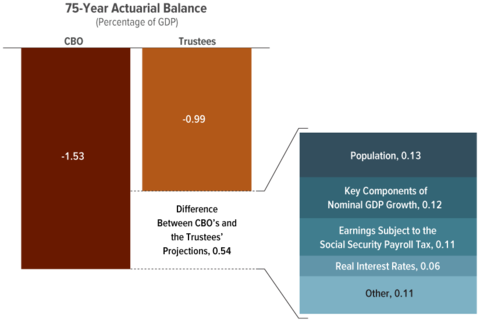
CBO’s Long-Term Social Security Projections: Changes Since 2018 and Comparisons With the Social Security Trustees’ Projections

In June 2019, CBO updated its long-term budget projections, including projections of the Social Security system’s finances. CBO compares those projections with its 2018 projections and with the Social Security trustees’ latest projections.

View Document

Read more!

Friday, November 8, 2019

Social Security Bulletin, Vol. 79, No. 4

Released November 2019.

The Use of Longitudinal Data on Social Security Program Knowledge

by Laith Alattar, Matt Messel, David Rogofsky, and Mark A. Sarney

This article presents and compares results from the first two waves of Understanding America Study (UAS) surveys of public knowledge about Social Security programs. The article briefly reviews the Social Security Administration's past efforts to gauge public knowledge of the programs, describes the UAS survey instrument used in the current effort, and presents survey results with detail by respondent age, education, and financial literacy level. Among the authors' findings are that younger workers with lower levels of education and financial literacy are logical targets for agency informational outreach and interventions.

Hispanics' Knowledge of Social Security: New Evidence

by Janice Peterson, Barbara A. Smith, and Qi Guan

Although Hispanics rely more on Social Security benefits for retirement income than other population groups, their knowledge about the programs is shallower. The authors of this article use data from a large Internet survey panel to identify gaps in Social Security knowledge between Hispanics and non-Hispanic whites and among Hispanics across ancestry and primary-language groups and test the statistical significance of their findings. The results offer insights for further research and guidance for policy that aims to promote retirement security for U.S. Hispanics.

The Comprehensive Wealth of Older Immigrants and Natives

by David Love and Lucie Schmidt

This article compares the retirement preparations of immigrant and native-born Americans aged 51 or older. The authors estimate the present value of future income streams in calculating measures of comprehensive wealth and an annualized equivalent. In addition to some significant differences in median annualized wealth between immigrants and natives, the authors find that the most recent waves of immigrants are more financially vulnerable in retirement than earlier immigration cohorts were at similar ages. With a decomposition analysis, the authors estimate how much of the immigrant-native wealth gap is attributable to differences in observable characteristics.

Read more!

Wednesday, October 30, 2019

New working papers from the Center for Retirement Research

The Center for Retirement Research at Boston College has recently released five working papers:

How Best to Annuitize Defined Contribution Assets?
Alicia H. Munnell, Gal Wettstein, and Wenliang Hou
How Do Older Workers Use Nontraditional Jobs?

Alicia H. Munnell, Geoffrey T. Sanzenbacher, and Abigail N. Walters 
Will More Workers Have Nontraditional Jobs as Globalization and Automation Spread?

Matthew S. Rutledge, Gal Wettstein, and Sara Ellen King
Do States Adjust Medicaid Enrollment in Response to Capitation Rates? Evidence from the Medicare Part D Clawback
Laura D. Quinby and Gal Wettstein
The Effect of Medicare Part D on Evergreening, Generic Entry, and Drug Prices
Geoffrey T. Sanzenbacher and Gal Wettstein

Read more!

Friday, September 20, 2019

New paper: “Promoting Economic Growth through Social Security Reform”

From Marc Goldwein, Maya MacGuineas and Chris Towner of the Committee for a Responsible Federal Budget.

Here’s the summary, but you can read the full paper here.

Summary of Recommendations for Pro-Growth Social Security Reform

Recommendation #1: Increase the Retirement Ages while Insulating Vulnerable Workers with an Age 62 Poverty Protection Benefit (62-PPB). One way to increase the size of the economy is to promote work among older Americans. Workers today face mixed retirement signals that often draw them into early retirement and treat retirement itself as a binary choice. To encourage longer and more flexible working lives, we propose phasing in an increase to Social Security’s early and normal retirement ages and then indexing them to growth in life expectancy. Understanding that many workers are unable to continue to work, we also propose offering all workers a 62-PPB benefit designed to insulate low-income workers from the financial effects of the age increases and ensure that anyone can retire at 62 without slipping into poverty.

Recommendation #2: Calculate Benefits Based on Each Year of Work Rather than Lifetime 35-Year Average Earnings. Higher labor force participation among workers of all ages can help to strengthen the economy. Yet the current Social  Security benefit formula imposes a significant implicit tax on those who work less than ten years and on workers later in their careers – especially after 35 years of work. To reward each year of work, we propose counting every year of earnings toward Social Security benefits and applying Social Security’s benefit formula to annual, rather than average, earnings through a formula known as “mini-PIA.”

Recommendation #3: Automatically Enroll Workers into a “Supplemental Retirement Account” (SRA) on top of Social Security, with the Choice to Opt Out. Increasing the national savings rate would boost overall investment, increasing capital stock and economic growth. Unfortunately, many workers lack access to retirement savings vehicles, or are saving too little for retirement. To increase savings and investment, we recommend enrolling workers into add-on SRAs and automatically contributing 2 to 3 percent of their wages unless a worker chooses to discontinue contributions. SRAs could be invested into one of several well-diversified, low-fee funds and would be owned by the worker, who could access the funds upon retirement.

Recommendation #4: Make Social Security Sustainably Solvent Through a Combination of Progressive Tax and Benefit Changes. Reducing federal borrowing can promote economic growth by reducing “crowd out” of private investment, while improving policy certainty can significantly improve saving and investment choices. Unfortunately, Social Security is running large and rising deficits, which increase federal debt and leave the program on course to exhaust its trust fund reserves by 2035. To make the program sustainably solvent, we suggest a package of progressive revenue and benefit adjustments that would protect low-income seniors, phase in gradually, and ultimately bring the program’s costs and revenues in line. We also suggest that the precise composition of this package be decided as part of a political negotiation.

We also suggest lawmakers consider other pro-growth reforms – as part of and to supplement Social Security reform – in order to maximize potential growth effects.

Read more!

Tuesday, September 17, 2019

Social Security Advisory Board announces meeting to review the 2019 Technical Panel final report

On Friday, September 27th the Social Security Advisory Board ("Board") will host a public meeting to review the 2019 Technical Panel on Assumptions and Methods' ("Technical Panel") report to the Board. The Board convened the independent, expert panel to review the assumptions and methods used to develop the annual report of the Social Security Trustees on the financial status of the Old-Age, Survivors, and Disability Insurance trust funds. The 2019 Technical Panel is the sixth quadrennial panel the Board has commissioned since 1999.

The 2019 Technical Panel is comprised of experts in the fields of demography, economics and actuarial science. The report reflects solely the views of the Technical Panel. The Board convened the Technical Panel, as well as past panels, in the hope that the work provides an important service to the public—an outside and expert review of the methods used to project Social Security financing.

The meeting will be held from 10:30 AM – 12:30 PM in Room 215, Dirksen Senate Office Building at 50 Constitution Avenue NE, Washington, DC 20002. Please email events@ssab.gov to RSVP if you plan to attend. The report will be available in electronic format only and will be posted on the Board’s website at least 48 hours in advance of the meeting.

Read the full announcement

Read more!

Monday, September 16, 2019

Savings and Retirement Foundation with Guest Sandy Mackenzie

Savings and Retirement Foundation

For a Lunch Meeting with Guest Speaker:

Sandy Mackenzie,

Founding editor

Journal of Retirement

September 24th, 2019

Noon-1:00 p.m.

RSVP

The Tax Foundation

1325 G Street NW

Washington DC 

Sandy Mackenzie is the founding editor of the Journal of Retirement and an experienced economic consultant and editor with a demonstrated history of working in non-profits, editorial supervision and economic policy, with an emphasis on fiscal policy. He has substantial experience with nonprofit organizations and skilled in the economics and finances of retirement, lecturing on fiscal, monetary and retirement issues, writing, and policy analysis. He holds a Master of Philosophy  in Economics from Oxford University.

Read more!

Thursday, September 12, 2019

CBO’s 2019 Long-Term Projections for Social Security: Additional Information

In lieu of publishing a separate report providing additional information about CBO’s long-term projections for Social Security, the agency is publishing the data that it would have presented in that report.

View Document

Read more!

Thursday, August 29, 2019

Social Security Bulletin, Vol. 79, No. 3

Released August 2019.

Download entire publication

The Social Security Windfall Elimination Provision: Issues and Replacement Alternatives

by Glenn R. Springstead

The Windfall Elimination Provision (WEP) reduces the Social Security benefits of individuals who would otherwise receive a full benefit based on earnings in Social Security–covered employment as well as pension income from noncovered employment. Since the WEP was established in 1983, critics have asserted that it overcorrects the would-be windfall for affected beneficiaries and is difficult to administer. This article considers two WEP replacement options that would modify the benefit calculation methodology. It compares the current WEP with the two options and discusses some of the possible effects of changing the current law.

Social Security Disability Insurance and Supplemental Security Income Beneficiaries with Multiple Impairments

by Elisa Walker and Emily Roessel

This article uses data from the Social Security Administration's National Beneficiary Survey and agency administrative records to estimate the number and examine the characteristics of adult disability-program beneficiaries with multiple impairments. In the survey, most beneficiaries report conditions in more than one impairment category. Beneficiaries with multiple impairments tend to have more activity limitations and poorer health than those reporting one impairment. They also tend to be older and to have higher household incomes than those with one impairment, and are less likely to have work-related goals and expectations. Administrative data contain fewer impairments per beneficiary and do not necessarily reflect the condition(s)that the beneficiary considers most limiting. Administrative data are complete for their purpose, but they may underrepresent the totality of disability that beneficiaries experience, and thus may be less predictive of employment and other outcomes than survey data.

The Time Between Disability Onset and Application for Benefits: How Variation among Disabled Workers May Inform Early Intervention Policies

by Matt Messel and Alexander Strand

This article examines how much time typically passes between disability onset and application for disability-program benefits, by age at onset and diagnosis. Among eventual applicants, certain subgroups might be suitable targets for employment-support interventions. Using Social Security administrative data, the authors find that the median period from onset to application is 7.6 months. Younger applicants tend to have waited longer, particularly those diagnosed with back impairments or arthritis. Among both younger and older applicants, individuals diagnosed with intellectual disability or other mental disorders are potential targets for early intervention programs because those groups wait the longest to apply and are the most likely to continue working in the interim.

Read more!